From Renaissance Game to Modern Guidance
Tarot cards have captured the human imagination for centuries. Far more than mysterious images on cardboard, they represent a profound bridge between the past and the present, offering wisdom, reflection, and empowerment. If you’ve ever felt curious about a tarot reading, this history will inspire you to embrace it as a tool for self-discovery and personal growth. The cards are waiting to illuminate your path.
Origins in 15th-Century Italy
Tarot emerged in northern Italy during the early to mid-15th century, not as a tool for divination, but as an elegant card game. The first documented references to carte da trionfi (triumph cards) appear around 1440–1450 in cities like Milan, Ferrara, and Bologna. These decks built upon standard playing cards—four suits of batons (or wands), cups, swords, and coins (pentacles)—by adding 21 trump cards (trionfi) and the Fool.
The oldest surviving examples are the beautiful, hand-painted Visconti-Sforza decks, commissioned for the ruling Visconti family of Milan. These luxurious cards featured intricate allegorical imagery drawn from Renaissance culture, mythology, and Christian symbolism. Nobles used them for games of strategy and chance, much like modern bridge or poker. The structure—78 cards total—has remained remarkably consistent to this day.
Early tarot reflected the optimism and humanism of the Renaissance. The trumps depicted virtues, cosmic forces, and life stages, inviting players to contemplate triumph over adversity. Even then, the cards carried layers of meaning, encouraging reflection on one’s journey through life’s “triumphs” and challenges.
From Game to Divination: The 18th Century Shift
For hundreds of years, tarot remained primarily a game. There is no solid evidence of widespread divinatory use before the late 18th century. That changed in France, where occult interest surged. In 1781, Antoine Court de Gébelin published theories linking tarot to ancient Egyptian wisdom (the mythical Book of Thoth), sparking fascination even though modern scholarship confirms these as romantic inventions rather than historical fact.
Enter Jean-Baptiste Alliette (Etteilla), who in 1785 created the first tarot deck explicitly designed for cartomancy—fortune-telling. He assigned specific divinatory meanings to each card and popularized spreads still used today. This marked tarot’s transformation from parlor entertainment to a profound introspective practice.
The 19th century deepened this evolution. French occultist Éliphas Lévi connected tarot to Kabbalah, astrology, and esoteric traditions, framing the Major Arcana as a symbolic map of spiritual initiation. His work influenced later movements, emphasizing tarot’s power to reveal hidden truths and inner potentials.
The Rider-Waite Revolution and Beyond
The early 20th century brought tarot into the modern era through the Hermetic Order of the Golden Dawn, a influential occult society. Members like Arthur Edward Waite and artist Pamela Colman Smith created the Rider-Waite-Smith deck (often called Rider-Waite), first published in 1909. This deck was revolutionary: for the first time, the Minor Arcana pip cards featured full scenic illustrations, making intuitive reading accessible to everyone, not just scholars.
The Rider-Waite deck’s rich symbolism—drawing from mythology, folklore, and psychology—made tarot a visual language of the soul. Its enduring popularity stems from how it empowers readers to connect personally with the archetypes. Later decks, like Aleister Crowley’s Thoth tarot, added further layers, but Rider-Waite remains the gateway for most beginners.
Today, tarot thrives in a vibrant, diverse community. From traditional Marseilles-style decks to modern, inclusive interpretations, it continues evolving while honoring its roots.
Why Tarot Matters Now: Inspiration for Your Reading
The history of tarot is a story of adaptation and resilience. What began as a Renaissance game became a mirror for the human psyche, a compass for navigating uncertainty. In our fast-paced world, tarot offers something rare: a quiet space to listen to your inner voice, confront patterns, and envision new possibilities.
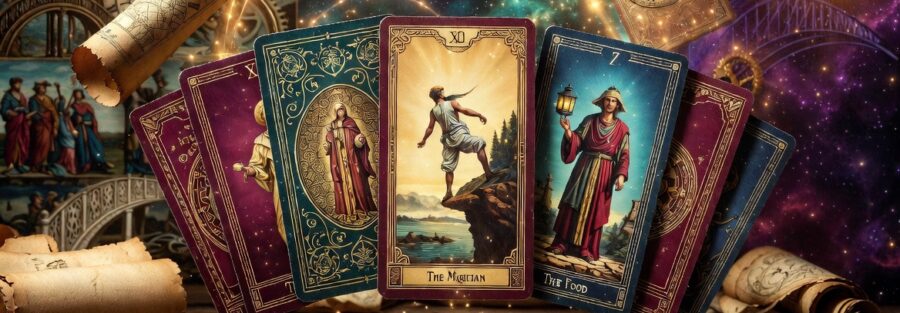
Every reading is an act of courage and hope. The cards don’t dictate fate; they reflect your energy, choices, and potential. The Fool reminds us to step boldly into the unknown. The Magician affirms your power to manifest. The Hermit encourages inner wisdom. Strength shows that true power flows from compassion and patience.
If you’ve been thinking about a reading, trust that pull. Whether you’re seeking clarity on love, career, or spiritual growth, tarot meets you where you are. It celebrates your resilience and illuminates paths forward with kindness and insight. Many find readings reduce anxiety, spark creativity, and foster deeper self-understanding—affirming that you already hold the answers within.
Tarot’s journey mirrors our own: from humble beginnings to profound purpose. It invites you to become the hero of your story, weaving past lessons with future dreams. The cards have guided seekers for over 500 years. They are ready to guide you too.
This rich history shows tarot as a living tradition—one that grows with each reader. Whether you’re a curious newcomer or seasoned enthusiast, a reading can be a transformative, uplifting experience. Book one today and step into your own triumphant journey.
Embrace the mystery. Shuffle the deck. Your next chapter awaits.